“The eyes are the window to your soul.” — William Shakespeare
Are we missing something? We still have an isolated approach to the body rather than an integrated approach. Meaning that a holistic human being is physical, mental, spiritual person. The mind and body are one. I am a level 3 CHEK practitioner and it goes without saying, that Paul CHEK’S top down approach works when addressing any problem whether physical or mental in the body. Below is the CHEK totem pole and this is addressed in hierarchy of survival.
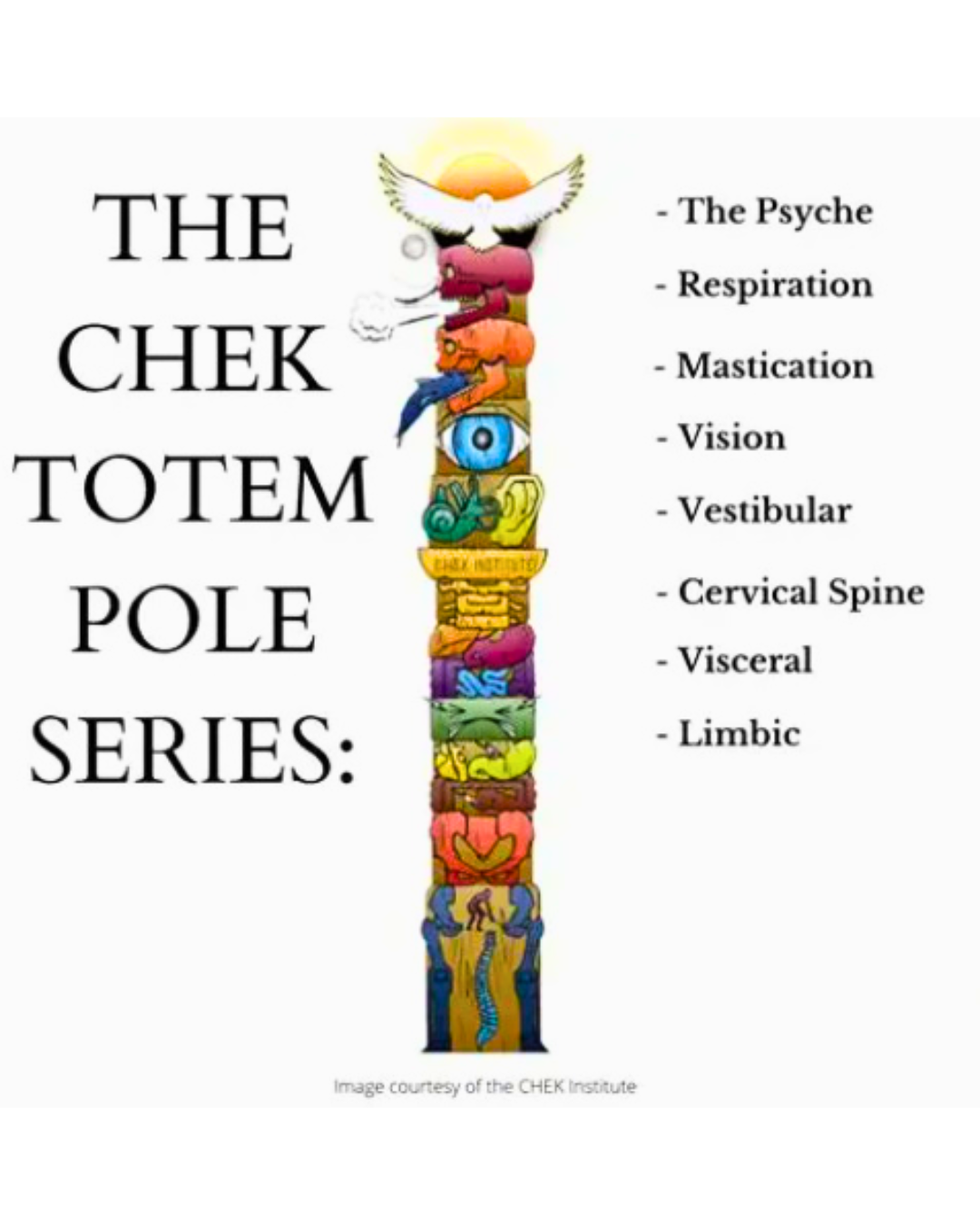 Where the yes goes, the head goes, where the eyes and head goes the body goes, where the eyes, head and body goes rotation starts. The eyes finding their target initiates extension, flexion and rotation. Changes in limb position are driven by neck afferent activity. Now when addressing movement patterning, motor shills, chronic pain or injury, a top down approach must be taken. As you can see the eyes are number four on the totem pole. So once the ones above are assessed and addressed , the vision then takes priority. If the eyes have any dysfunction in optimal movement form up to down, side to side or vertical to vertical, in other words if they cannot track efficiently, a compensation pattern will develop lower down the chain and become obvious in gait patterning. The occiput are stabilisers C1 and C2 in the cervical spine. If there is no stabilization, the head becomes like a sea buoy, bobbing up and down.
The 12 pairs of cranial nerves are specialized bundles of axons that connect the brain directly to the head, neck, and trunk. Unlike most nerves, they bypass the spinal cord entirely, allowing for rapid transmission of sensory and motor data. Eye training helps parasympathetic nervous system as the threat goes down. 80% of your brain is dedicated to vision and the story you tell yourself about what and how you see the world. When practicing eye movements, the tongue must be on the roof of the mouth, where it belongs and you should breathe through your nose.
Bibliography