
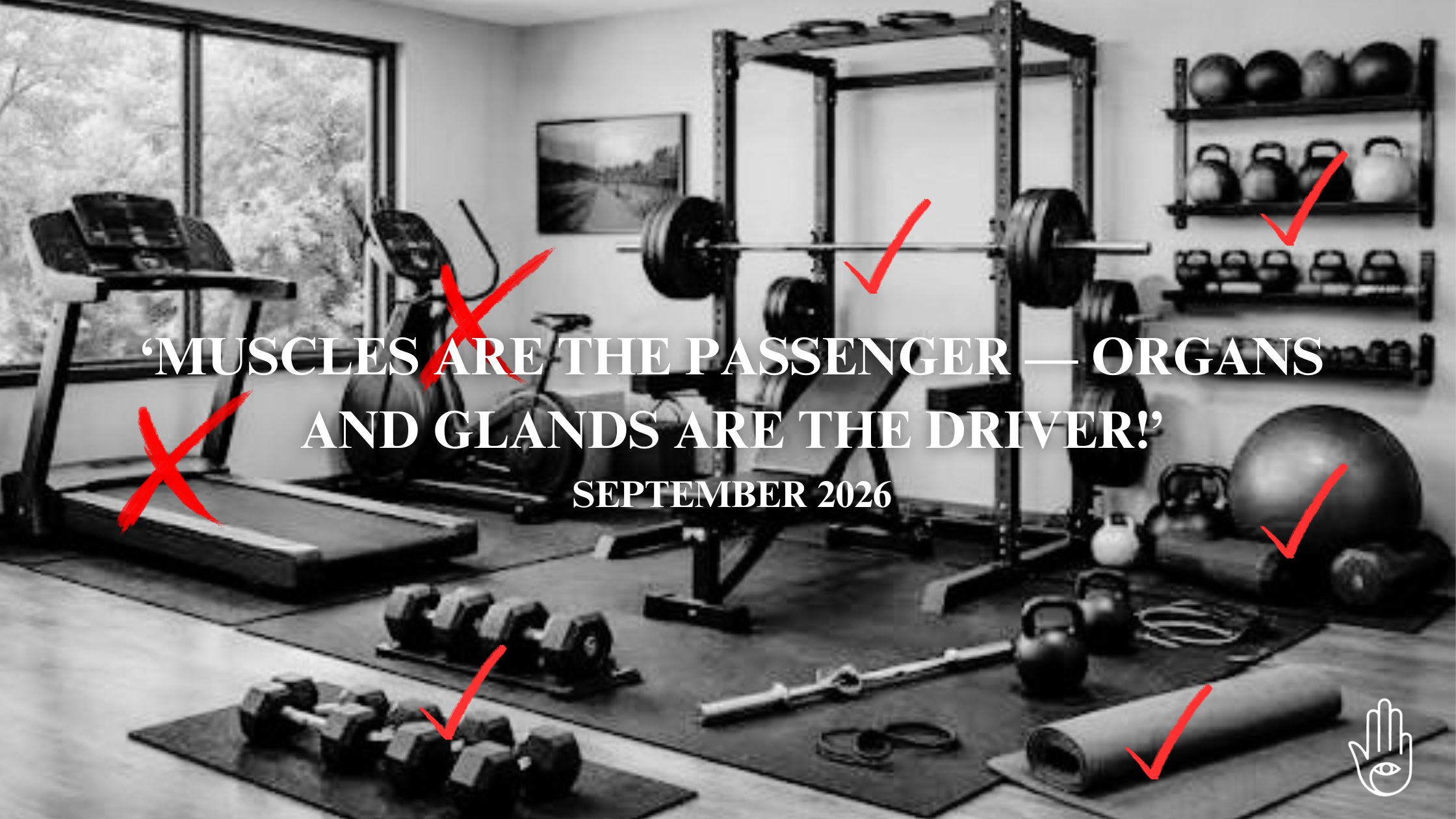
The quote is correct from a functional movement point of view with reference to training elite sports people to become better at their game. Real sports performance happens on your feet, on the pitch, under the load of your own body weight and external resistance. However there are two missing key points with regards to machine training and Pilates. So firstly in order for the the skeletal system to change it has to be loaded. I prefer weight training for this, with precise attention and programming to reps, sets, loads and tempo. The client needs specific muscle type targeting and needs to look at the key skills they need for them. These are known as biometer abilities as first presented by Tudar Bompa in his book: ‘Theories and methodologies of strength training’. He included the following qualities:
- Strength
- Power
- Endurance
- Speed
- Co-ordination
- Flexibility
- Agility
- Balance
In general machines in the gym machines which fix your axis will actually decondition your body and create poor patterns in your central nervous system. This is because you are fixed, with a false sense of stability. These machines include leg, arm, squat and other newer machines that focus on quads, hamstrings and shoulders. During the 1980s, 1990s and into the early 2000s, some gyms placed enormous emphasis on fixed-axis machines, while free weights were often viewed as unnecessarily risky and unsafe. Matt Wallden (Chek Faculty) explains, is that there are different ways to define “safe”.
‘A machine controls much of the movement pathway for you, which may reduce certain immediate risks associated with handling a free weight. At the same time, that external stability can reduce the requirement for your own body to stabilise while the prime movers generate force.That distinction becomes important when you leave the gym, because sport and everyday life rarely provide a perfectly controlled movement pathway. Paul Chek was one of the educators who strongly challenged the industry’s reliance on machine-based training, arguing for an approach that developed strength alongside the stabilisation, coordination and movement skills required to use it. This doesn’t mean that machines have no place within a programme, but it does challenge a much bigger assumption: If the machine is providing the stability while you build the strength, how well prepared are you to use that strength when the machine is no longer there?’ 1
Human biomechanics developed naturally. From the womb through young adulthood, your body learned to move, stabilize, and express force in three dimensions against gravity.
So machines I like in the gym which are functional would be things like the cable machine, free weights, barbell, pull up bar and lat pull down. Other freestyle equipment which are a must would be swiss ball, medicine ball, tornado ball, kettle bells, bulgarian bags, flow rope, dowel rod and many others. This is my first point, the movements above uses what’s called open and closed chain exercises.
An open chain exercise example would be a pull up in which the distal extremity is free to move and the exerciser can overcome the object that force is being applied to. A closed chain exercise example would be where the distal extremity is fixed and the exerciser is unable to overcome the object that the body is pushing or pulling against gravity.
It is always best to train the nervous system for situations where the base of support is challenged, you need to challenge the client during training. The more control that an athlete has during an unstable position, the better he/she will be able to perform, particularly if the environment of application is more stable than the training age.
My second point is that pilates like yoga, tai chi, GYROTONIC is an art. It was never meant to resemble cable machines and machine sliding back and forth doing fitness type exercises. Although this is many peoples preferred way to move and is a great accompaniment or start to movement. Classical Pilates is a system working with gravity and moving the body into many different shapes and positions like yoga except they use reps with body weight and many pieces of apparatus including Tower, Cadillac, reformer, Stability chair, electric chair, guillotine, ladder barrel, mat-work plus smaller equipment such as magic circle.
They also utilise like functional movement and other movement modalities, a righting reflex response (a stable support) and a tilting reflex response(unstable or moving surface). I work with high end professional athletes in particular professional footballers on their Yin qualities (anabolic repair), so this includes using Garuda, yoga, pilates, breathwork and slow functional movement on their working in more recovery days. Pilates Manchester frame does not completely removes necessary gravitational loading. I work as movement therapist, to help athletes discover more of who they are. Movement is our first perception in life. Injuries and faulty engrams can be traced back to infant development. Having the ability to regress a client back down and then rebuild back up is where the true power lies.
The neck is the most proprioceptive part of the body!
There are twelve pairs of cranial nerves which process three major types of information:
- Social senses of the head – touch to head, taste, smell, hearing and vision.
- Movement of the whole body
- Visceral activity
Of all these cranial nerves, the first pair to myelinate in order of their importance are the vestibular tissues. The vestibular nerves myelinate in order of their important role for survival by movement of the foetus and the environment.
The footballers feedback is that my combined system helps them with their breathing, mobility, agility, stride length, rotation and focus. They already have their own speed coaches plus strength and conditioning trainers at the clubs. This is not something I am trying to take over, but merely help as part of a co-operating open minded team.
During the world cup I saw many footballers flock to pilates studios, while this is a bonus, many where prescribed inappropriate exercises and were not take through the system. Remember there is no such thing as a bad exercise but there is such thing as badly prescribed exercise. Slowly down is something we all need to do in life. All professional footballers constantly need assessing rather a one size fits all.
If your training removes the natural demands of gravity, your nervous system fails to learn how to properly fire your stabilizing muscles when you are running, cutting, or tackling at high speeds.
“Pilates is gaining the mastery of your mind over the complete control over your body.” – Joseph Pilates
Bibliography
‘Primal Pattern’ by Paul Chek
‘Basic Neuromuscular Patterns’ – Bonnie Bainbridge Cohen
‘Sensing Feeling and Action’ – Bonnie Bainbridge Cohen
1 Machine training – Video | Facebook