At dance college we had what was called: ‘Limbering sessions’, these were ballistic type bouncing sessions to improve our flexibility in order to increase leg height, hip openers and turn out, but did this really help, and was it the right thing? Stretching isn’t enough, and you will now find out why mobility is the real game changer!
When I first assess a client on a one to basis, I take them through what’s called; ‘The Beighton score’. This is a nine point scale used to assess joint hypermobility and screen for conditions like Ehlers-Danlos syndrome or benign joint hypermobility syndrome. The test also shows hypo-mobility which is the other extreme, which is the majority of the population with limited range of motion.
Getting Started
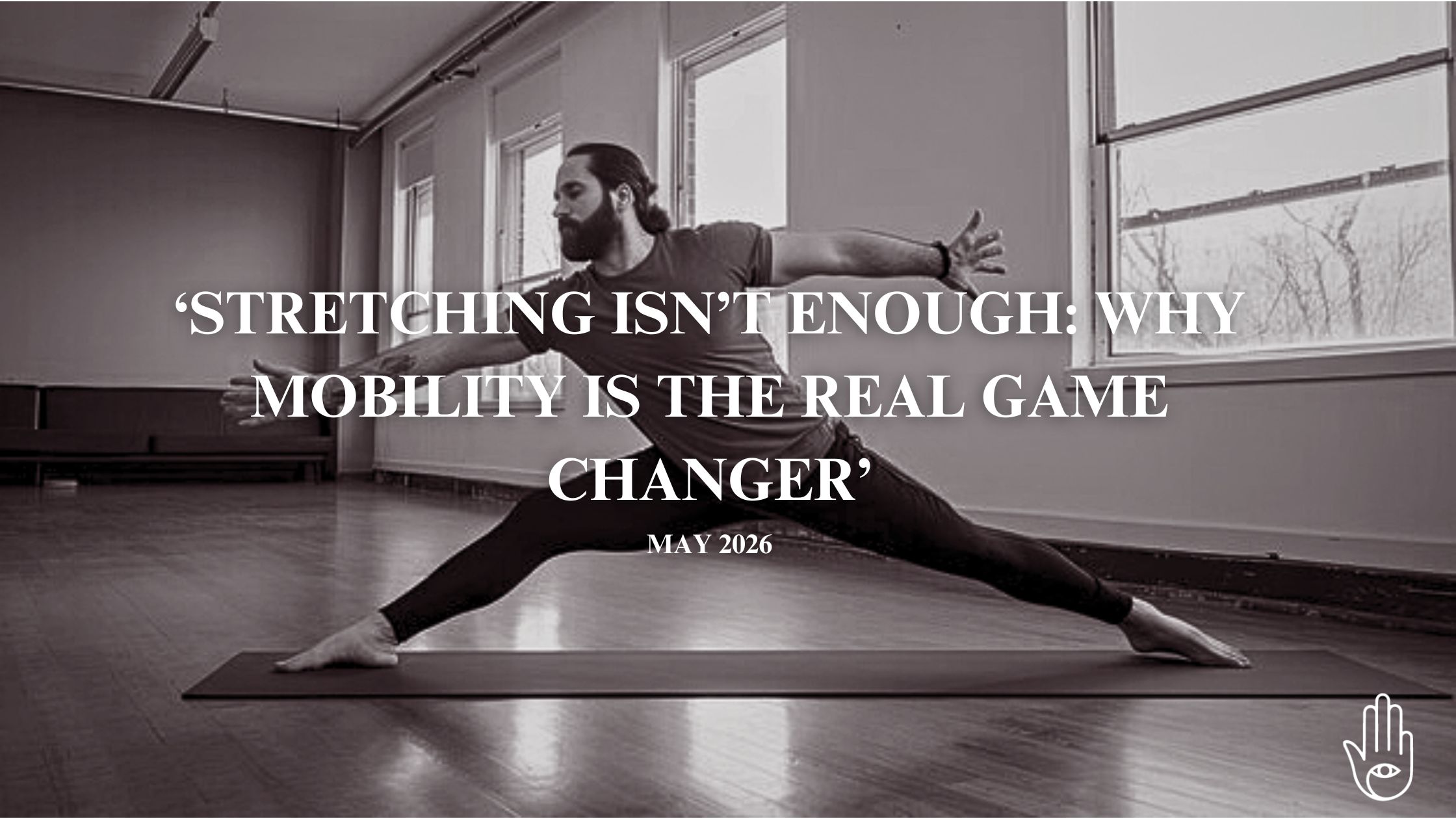
Touching your toes, doing the splits, sitting legs crossed and doing back bends are just a few of the moves which require excellent joint range of motion which is called mobility. You cannot change the depth of your hip sockets, you are either shallow or deep, you cannot change the length of the neck of the femur, you may have a chance of changing the angle of the femur head by doing alot of work on your flexibility (connective tissues). Read my blog on femur angle here:
So what is the difference between mobility and flexibility?
Mobility is the ability of the joint to move freely through its full ROM while maintaining control, strength and co-ordination. Mobility requires flexible connective tissues in around the joint body, neuromuscular control and stability. Optimal of the two will show a good squat pattern for example with adequate ROM at the ankles, knees ad hips.
Flexibility refers to the ability of the connective tissues like muscles, tendons and ligaments to elongate, lengthen and pandiculate smoothly.
My personal experience is that hyper mobile people will be attracted to activities such as Pilates, gymnastics, dance, yoga, and various types of martial arts. All the Pilates original work or exercise demonstrated correctly are always with someone who is hypermobile. The real skill is to coach the hypomobile person through modifications so that they can freedom in their body.
Most people mistake hypermobility for flexibility, I have seen this in many yogis before. Their ability to mobilise from the main joint of the hip is great, but restrict the range to knee extension at a 90 degree angle and you can see the lack of flexibility.
The fascia perspective
Don’t lose heart, you can still increase your flexibility by looking at many other variants including hydration, sleep, diet, breathing, mindset and movement. Our tissues are always a reflection of our daily habits, choices and most importantly the state of our central nervous system.
Remember when the body is in fight and flight, stress and tension, catabolic breakdown happens. Hence nutrition is key, a diet of coffee and cake prevents anabolic repair and is an ideal environment for pathogens to grow and thrive. The fascia perspective is so much more than just a foam roller and lying down on a lacrosse ball.
‘Fascia plays a critical role in mobility, flexibility, and athletic performance. Fascia is a network of connective tissue that weaves throughout the body, surrounding muscles, bones, nerves, and organs. While it once flew under the radar in discussions of fitness and health, it is now gaining recognition as a cornerstone of movement, injury prevention, and recovery. Understanding fascia and how to care for it—through techniques like foam rolling—can revolutionize the way athletes and fitness enthusiasts approach their training’.1
Alternatives to stretching
Stretching is not always the best way for clients. Techniques similar to animal moves, flows such as pandiculation, chi kung, tai chi and ‘The Garuda method’, have profound results on recovery and intervention. Loading the tissue with elastic, cables and weights using breath and a coil/recoil (concentric/eccentric) can also help loosen up the tissues. Try different positions in which to lifting your arms above the head, so sitting, lying and standing.
Our bodies never lie, we hold our movement patterns, by the way we live our life and our feeling. The body and emotion can never be separated. Our childhood wounds often show as pain later on in life. So whether you are a professional footballer, a desk worker, a taxi driver or a little lady bingo, it’s never too late to change habits of a lifetime.
‘What we think determines what happens to us, so if we want to change our lives, we need to stretch our minds’ – Wayne Dyer
Bibliography
Paul Chek – Media
Paul Thornley – The Body Isn’t Mechanical: Fascia, Movement & Living in the Round with Paul Thornley
Julian Baker – Re-think how you treat stiffness & injury